
Aplicaciones clínicas de la inteligencia artificial en mamografía
Desafíos y oportunidades en la práctica radiológica
DOI:
https://doi.org/10.20983/cienciavital.2026.03.sal.02Palabras clave:
Inteligencia artificial, Mamografía, Cáncer de mama, DiagnósticoResumen
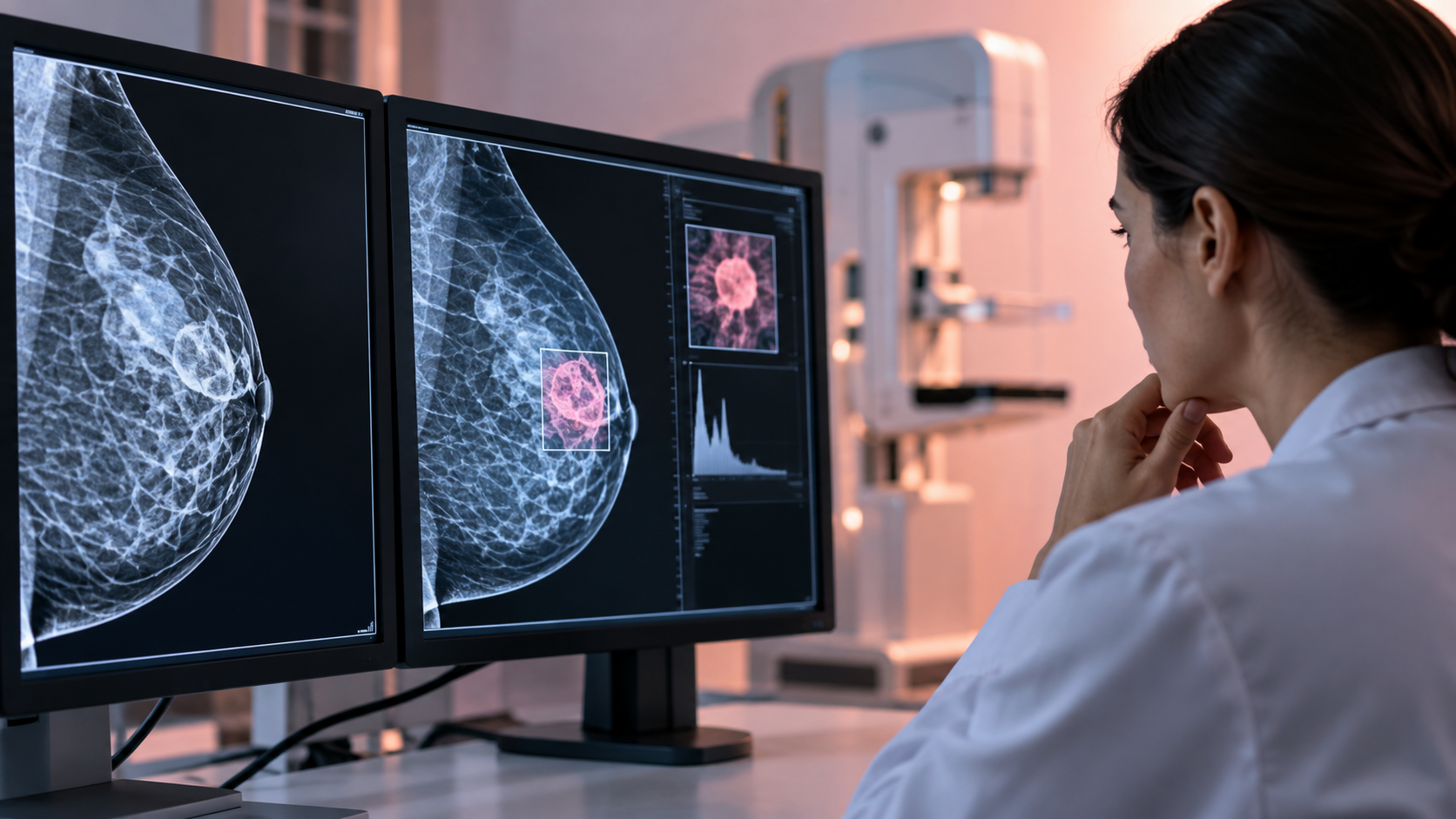
La inteligencia artificial está transformando la interpretación de las mamografías y abre nuevas posibilidades para apoyar la detección temprana del cáncer de mama. Aunque la mamografía es fundamental para identificar la enfermedad antes de que aparezcan síntomas, factores como la densidad del tejido mamario, la fatiga visual y las diferencias de interpretación entre especialistas pueden dificultar el diagnóstico. En este contexto, la IA puede funcionar como una aliada del radiólogo al priorizar estudios, señalar regiones sospechosas y reducir la carga de trabajo. Este artículo presenta las principales formas en que esta tecnología se incorpora al análisis de mamografías, así como sus beneficios y desafíos. Si bien puede contribuir a detectar más casos y hacer más eficiente la atención, también plantea riesgos relacionados con falsas alarmas, sesgos, privacidad y responsabilidad ante posibles errores. Su implementación gradual, transparente y supervisada puede ayudar a aprovechar sus beneficios sin sustituir el juicio clínico y el componente humano de la atención médica.
Citas
F. Bray, M. Laversanne, H. Sung, J. Ferlay, R. L. Siegel, I. Soerjomataram, and A. Jemal, “Global cancer statistics 2022: GLOBOCAN estimates of incidence and mortality worldwide for 36 cancers in 185 countries,” CA Cancer J. Clin., vol. 74, no. 3, pp. 229–263, May 2024, doi: https://doi.org/10.3322/caac.21834.
Colegio y Asociación Mexicana de Patólogos, A.C., Consenso mexicano sobre diagnóstico y tratamiento del cáncer mamario, 11th ed., México, 2025. [Online]. Available: https://ampatologia.org/amp/static/descargas/CONSENSO_CANCER_MAMA_2025.pdf.
C. E. Ventura-Alfaro, “Errores de medición en la interpretación mamográfica por radiólogos,” Rev. Salud Pública, vol. 20, no. 4, pp. 518–522, 2018.
K. Lång et al., “Artificial intelligence-supported screen reading versus standard double reading in the Mammography Screening with Artificial Intelligence (MASAI) trial,” Lancet Oncol., vol. 24, no. 8, pp. 936–944, Aug. 2023, doi: https://doi.org/10.1016/S1470-2045(23)00298-X.
N. Eisemann, S. Bunk, T. Mukama, H. Baltus, S. A. Elsner, et al., “Nationwide real-world implementation of AI for cancer detection in population-based mammography screening,” Nat. Med., vol. 31, no. 3, pp. 917–924, Mar. 2025, doi: https://doi.org/10.1038/s41591-024-03408-6.
S. M. McKinney et al., “International evaluation of an AI system for breast cancer screening,” Nature, vol. 577, no. 7781, pp. 89–94, Jan. 2020, doi: https://doi.org/10.1038/s41586-019-1799-6.
A. N. Ng et al., “Prospective implementation of AI-assisted screen reading to improve early detection of breast cancer,” Nat. Med., vol. 29, no. 12, pp. 3044–3049, Dec. 2023, doi: https://doi.org/10.1038/s41591-023-02625-9.
L. E. Philpotts, “Evaluating whether standalone AI really stands up,” Radiology, vol. 315, no. 1, Apr. 2025, doi: https://doi.org/10.1148/radiol.250364.
A. Rodriguez-Ruiz et al., “Detection of breast cancer with mammography: Effect of an artificial intelligence support system,” Radiology, vol. 290, no. 2, pp. 305–314, Feb. 2019, doi: https://doi.org/10.1148/radiol.2018181371.
A. Rodriguez-Ruiz et al., “Stand-alone artificial intelligence for breast cancer detection in mammography: Comparison with 101 radiologists,” J. Natl. Cancer Inst., vol. 111, no. 9, pp. 916–922, Sep. 2019, doi: https://doi.org/10.1093/jnci/djy222.
C. Monaldi et al., “Artificial intelligence in radiology: Navigating medical responsibility and bias,” Diagnostics, vol. 14, no. 14, 2024, doi: https://doi.org/10.3390/diagnostics14141506.
E. J. Topol, “High-performance medicine: The convergence of human and artificial intelligence,” Nat. Med., vol. 25, pp. 44–56, 2019, doi: https://doi.org/10.1038/s41591-018-0300-7.
B. B. Ozcan, B. E. Dogan, Y. Xi, and E. E. Knippa, “Perception of patients regarding the use of artificial intelligence in screening mammography interpretation: A survey study,” Radiology: Artificial Intelligence, 2024, doi: https://doi.org/10.1148/rycan.240290.
Radiological Society of North America (RSNA), “Radiologist fatigue, experience affect breast imaging call backs,” Jan. 11, 2022. [Online]. Available: https://www.rsna.org/media/press/i/2323. [Accessed: Apr. 12, 2026].
Y. Chen, G. J. W. Partridge, M. Vazirabad, R. L. Ball, H. M. Trivedi, F. C. Kitamura, H. M. L. Frazer, et al., “Performance of algorithms in the 2023 RSNA screening mammography breast cancer detection AI challenge,” Radiology, Aug. 2025, doi: https://doi.org/10.1148/radiol.241447.
Publicado
Número
Sección
Licencia
Derechos de autor 2026 Yazmín Mireles, José David Díaz Román, Boris Mederos-Madrazo, Lidia Rascón-Madrigal

Esta obra está bajo una licencia internacional Creative Commons Atribución-NoComercial-CompartirIgual 4.0.