
Más allá de la cocina: el nopal como biopolímero con usos innovadores
DOI:
https://doi.org/10.20983/cienciavital.2026.01.bas.01Palabras clave:
Opuntia ficus indica, Nopal, Mucílago de nopal, BiopolímeroResumen
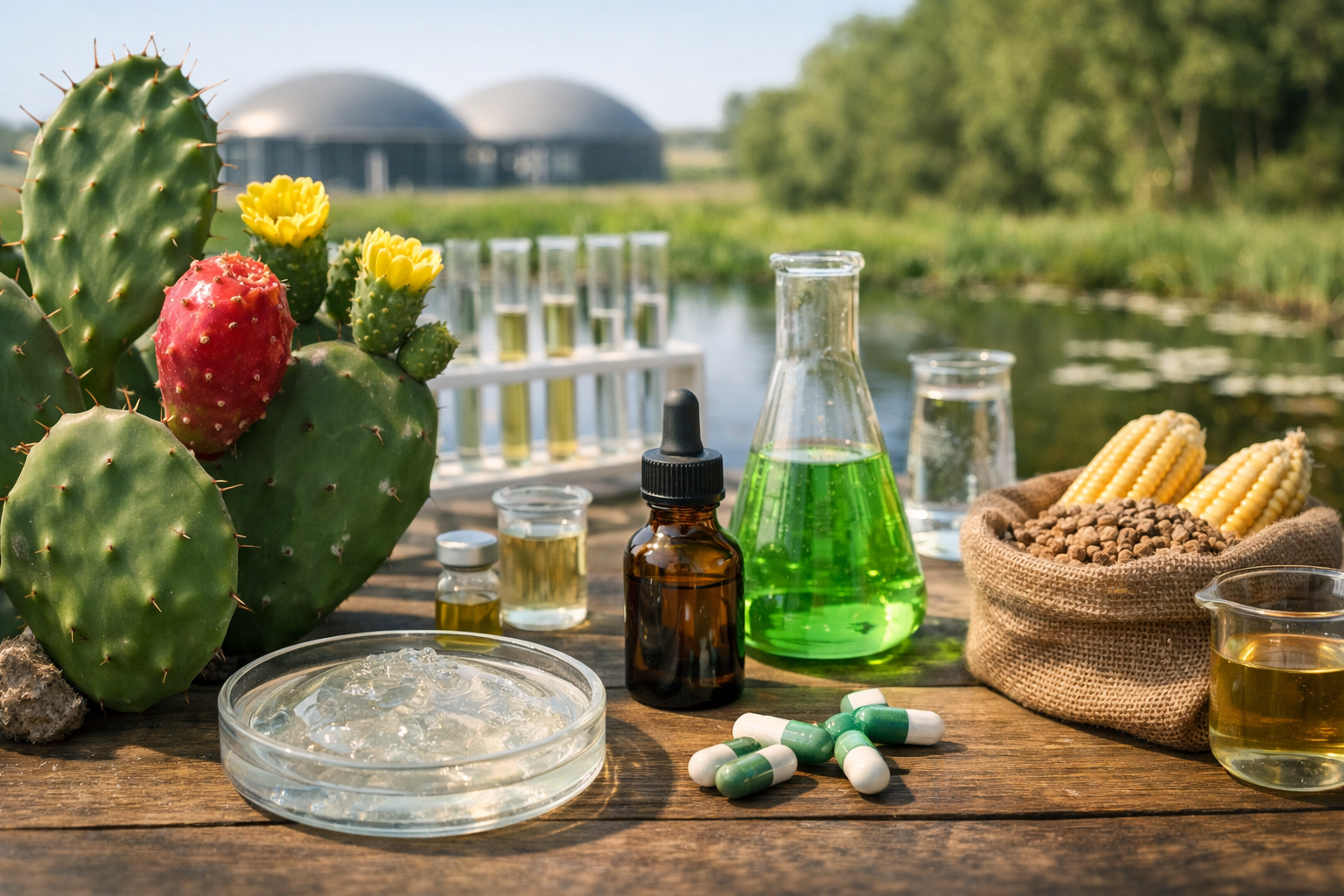
El nopal (Opuntia ficus indica) es una planta profundamente ligada a la cultura y alimentación en México, pero su importancia va mucho más allá de la cocina. Originaria de este país, forma parte de un género del que se han identificado alrededor de 110 especies. El nopal está compuesto por varias partes, como los cladodios o pencas (tallos planos donde se almacena agua), la fruta conocida como tuna, además de flores y semillas. Este artículo explora cómo una sustancia natural presente en el nopal, llamada mucílago, puede actuar como biopolímero, es decir, un material natural con propiedades similares a ciertos plásticos o geles industriales. Gracias a estas características, el nopal se investiga para diversas aplicaciones innovadoras: desde la encapsulación de medicamentos para mejorar su liberación en el organismo, hasta su uso en tratamiento de aguas, producción de biocombustibles, alimentación animal y empaques biodegradables para alimentos. Estos avances muestran que una planta tradicional puede convertirse en una alternativa sostenible para desarrollar nuevas tecnologías, contribuyendo al cuidado del ambiente y al aprovechamiento de recursos naturales con gran potencial para la sociedad.
Citas
X. Zhong, X. Jin, F. Lai, Q. Lin and J. Jiang, “Chemical analysis and antioxidant activities in vitro of polysaccharide extracted from Opuntia ficus indica Mill. cultivated in China,” Carbohydrate Polymers, vol. 82, no. 3, pp. 722–727, 2010, doi: https://doi.org/10.1016/j.carbpol.2010.05.042.
A. R. Garcia, “Meta-analysis: Effects of Opuntia species,” tesis de maestría, University of North Texas Health Science Center at Fort Worth, 2000.
M. Aragona, E. R. Lauriano, S. Pergolizzi and C. Faggio, “Opuntia ficus-indica (L.) Miller as a source of bioactivity compounds for health and nutrition,” Natural Product Research, vol. 32, no. 17, pp. 2037–2049, 2018, doi: https://doi.org/10.1080/14786419.2017.1365073.
C. Sáenz, E. Sepúlveda and B. Matsuhiro, “Opuntia spp. mucilage’s: A functional component with industrial perspectives,” Journal of Arid Environments, vol. 57, no. 3, pp. 275–290, 2004, doi: https://doi.org/10.1016/S0140-1963(03)00106-X.
F. J. Barba et al., “Opuntia ficus indica edible parts: A food and nutritional security perspective,” Food Reviews International, 2020, doi: https://doi.org/10.1080/87559129.2020.1756844.
S. Bensadón, D. Hervert-Hernández, S. G. Sáyago-Ayerdi and I. Goñi, “By-products of Opuntia ficus-indica as a source of antioxidant dietary fiber,” Plant Foods for Human Nutrition, vol. 65, no. 3, pp. 210–216, 2010, doi: https://doi.org/10.1007/s11130-010-0176-2.
L. Andreu, N. Nuncio-Jáuregui, Á. A. Carbonell-Barrachina, P. Legua and F. Hernández, “Antioxidant properties and chemical characterization of Spanish Opuntia ficus-indica Mill. cladodes and fruits,” Journal of the Science of Food and Agriculture, vol. 98, no. 4, pp. 1566–1573, 2018, doi: https://doi.org/10.1002/jsfa.8628.
D. Torres-Ponce, R. L. Morales-Corral, M. de L. Ballinas-Casarrubias and G. V. Nevárez-Moorillón, “El nopal: planta del semidesierto con aplicaciones en farmacia, alimentos y nutrición animal,” Revista Mexicana de Ciencias Agrícolas, vol. 66, pp. 1129–1142, 2015.
C. G. Hernández-Carrillo, J. A. Gómez-Cuaspud and C. E. Martínez Suarez, “Compositional, thermal and microstructural characterization of the nopal (Opuntia ficus indica) for addition in commercial cement mixtures,” Journal of Physics: Conference Series, vol. 935, p. 012045, 2017, doi: https://doi.org/10.1088/1742-6596/935/1/012045.
E. Sepúlveda, C. Sáenz, E. Aliaga and C. Aceituno, “Extraction and characterization of mucilage in Opuntia spp.,” Journal of Arid Environments, vol. 68, no. 4, pp. 534–545, 2007, doi: https://doi.org/10.1016/j.jaridenv.2006.08.001.
P. I. Angulo-Bejarano and O. Paredes-López, “Nopal: A perspective view on its nutraceutical potential,” ACS Symposium Series, vol. 1109, pp. 113–159, 2012, doi: https://doi.org/10.1021/bk-2012-1109.ch009.
S. M. Miller, E. J. Fugate, V. O. Craver, J. A. Smith and J. B. Zimmerman, “Toward understanding the efficacy and mechanism of Opuntia spp. as a natural coagulant for potential application in water treatment,” Environmental Science & Technology, vol. 42, no. 12, pp. 4274–4279, 2008, doi: https://doi.org/10.1021/es7025054.
C. López-Palacios, C. B. Peña-Valdivia, A. I. Rodríguez-Hernández and J. A. Reyes-Agüero, “Rheological flow behavior of structural polysaccharides from edible tender cladodes of wild, semidomesticated and cultivated ‘nopal’ (Opuntia) of Mexican highlands,” Plant Foods for Human Nutrition, vol. 71, pp. 388–395, 2016, doi: https://doi.org/10.1007/s11130-016-0573-2.
E. Salehi, Z. Emam-Djomeh, G. Askari and M. Fathi, “Opuntia ficus indica fruit gum: Extraction, characterization, antioxidant activity and functional properties,” Carbohydrate Polymers, vol. 206, pp. 565–572, 2019, doi: https://doi.org/10.1016/j.carbpol.2018.11.035.
A. Negre-Salvayre et al., “Phenolic compounds accumulation in wild and domesticated cladodes from Opuntia spp.,” ACS Symposium Series, vol. 1286, pp. 371–382, 2018, doi: https://doi.org/10.1021/bk-2018-1286.ch020.
G. Ginestra et al., “Anatomical, chemical, and biochemical characterization of cladodes from prickly pear,” Journal of Agricultural and Food Chemistry, vol. 57, no. 21, pp. 10323–10330, 2009, doi: https://doi.org/10.1021/jf9022096.
R. I. Ventura-Aguilar, E. Bosquez-Molina, S. Bautista-Baños and F. Rivera-Cabrera, “Cactus stem (Opuntia ficus-indica Mill): anatomy, physiology and chemical composition with emphasis on its biofunctional properties,” Journal of the Science of Food and Agriculture, vol. 97, no. 15, pp. 5065–5073, 2017, doi: https://doi.org/10.1002/jsfa.8493.
M. I. Hernández-Urbiola et al., “Study of nutritional composition of nopal (Opuntia ficus indica cv. Redonda) at different maturity stages,” The Open Nutrition Journal, vol. 4, pp. 11–16, 2010, doi: https://doi.org/10.2174/1874288201004010011.
M. Missaoui et al., “Characterization of micronutrients, bioaccessibility and antioxidant activity of prickly pear cladodes,” Molecules, vol. 25, 2020, doi: https://doi.org/10.3390/molecules25092176.
J. L. Guerrero Rodríguez, “Diseño del proceso industrial para la obtención de vino a base de tuna (Opuntia ficus indica),” tesis de licenciatura, Escuela Superior Politécnica de Chimborazo, 2018.
R. Ciriminna, N. Chavarría-Hernández, A. I. Rodríguez-Hernández and M. Pagliaro, “Toward unfolding the bioeconomy of nopal (Opuntia spp.),” Biofuels, Bioproducts and Biorefining, vol. 13, pp. 1417–1427, 2019, doi: https://doi.org/10.1002/bbb.2018.
J. M. Feugang, “Nutritional and medicinal use of cactus pear (Opuntia spp.) cladodes and fruits,” Frontiers in Bioscience, vol. 11, p. 2574, 2006, doi: https://doi.org/10.2741/1992.
D. I. Fox, T. Pichler, D. H. Yeh and N. A. Alcantar, “Removing heavy metals in water: The interaction of cactus mucilage and arsenate,” Environmental Science & Technology, vol. 46, no. 8, pp. 4553–4559, 2012, doi: https://doi.org/10.1021/es2021999.
L. R. Camelo Caballero et al., “Preparation and physicochemical characterization of softgels cross-linked with cactus mucilage extracted from cladodes of Opuntia ficus-indica,” Molecules, vol. 24, p. 2531, 2019, doi: https://doi.org/10.3390/molecules24142531.
I. Ammar, M. Ennouri and H. Attia, “Phenolic content and antioxidant activity of cactus flowers according to extraction method,” Industrial Crops and Products, vol. 64, pp. 97–104, 2015, doi: https://doi.org/10.1016/j.indcrop.2014.11.030.
J. Wiese, S. McPherson, M. C. Odden and M. G. Shlipak, “Effect of Opuntia ficus indica on symptoms of alcohol hangover,” Archives of Internal Medicine, vol. 164, no. 12, p. 1334, 2004, doi: https://doi.org/10.1001/archinte.164.12.1334.
J. A. Figueirôa et al., “Opuntia ficus-indica as biosorbent for chromium removal in leather industry effluents,” Heliyon, vol. 7, p. e07292, 2021, doi: https://doi.org/10.1016/j.heliyon.2021.e07292.
J. H. Han, “Edible films and coatings: A review,” in Innovations in Food Packaging, 2nd ed., pp. 213–255, 2014, doi: https://doi.org/10.1016/B978-0-12-394601-0.00009-6.
G. F. A. de Souza et al., “Opuntia ficus-indica mucilage: A sustainable bio-additive for cementitious materials,” Construction and Building Materials, vol. 456, p. 139254, 2024, doi: https://doi.org/10.1016/j.conbuildmat.2024.139254.
E. M. Galati et al., “Opuntia ficus indica mucilages show cytoprotective effect on gastric mucosa in rat,” Phytotherapy Research, vol. 21, pp. 344–346, 2007, doi: https://doi.org/10.1002/ptr.2075.
N. Bayar, M. Kriaa and R. Kammoun, “Extraction and characterization of three polysaccharides extracted from Opuntia ficus indica cladodes,” International Journal of Biological Macromolecules, vol. 92, pp. 441–450, 2016, doi: https://doi.org/10.1016/j.ijbiomac.2016.07.042.
R. Gheribi and K. Khwaldia, “Cactus mucilage for food packaging applications,” Coatings, vol. 9, no. 10, p. 655, 2019, doi: https://doi.org/10.3390/coatings9100655.
Publicado
Número
Sección
Licencia
Derechos de autor 2026 Q.F.B. Emilio Juárez Hernández, Dra. Santos Adriana Martel Estrada

Esta obra está bajo una licencia internacional Creative Commons Atribución-NoComercial-CompartirIgual 4.0.