
Bismuto: el oro amarillo mexicano de la ciencia
DOI:
https://doi.org/10.20983/cienciavital.2026.01.apl.01Palabras clave:
bismuto, tratamiento de aguas, minería en MéxicoResumen
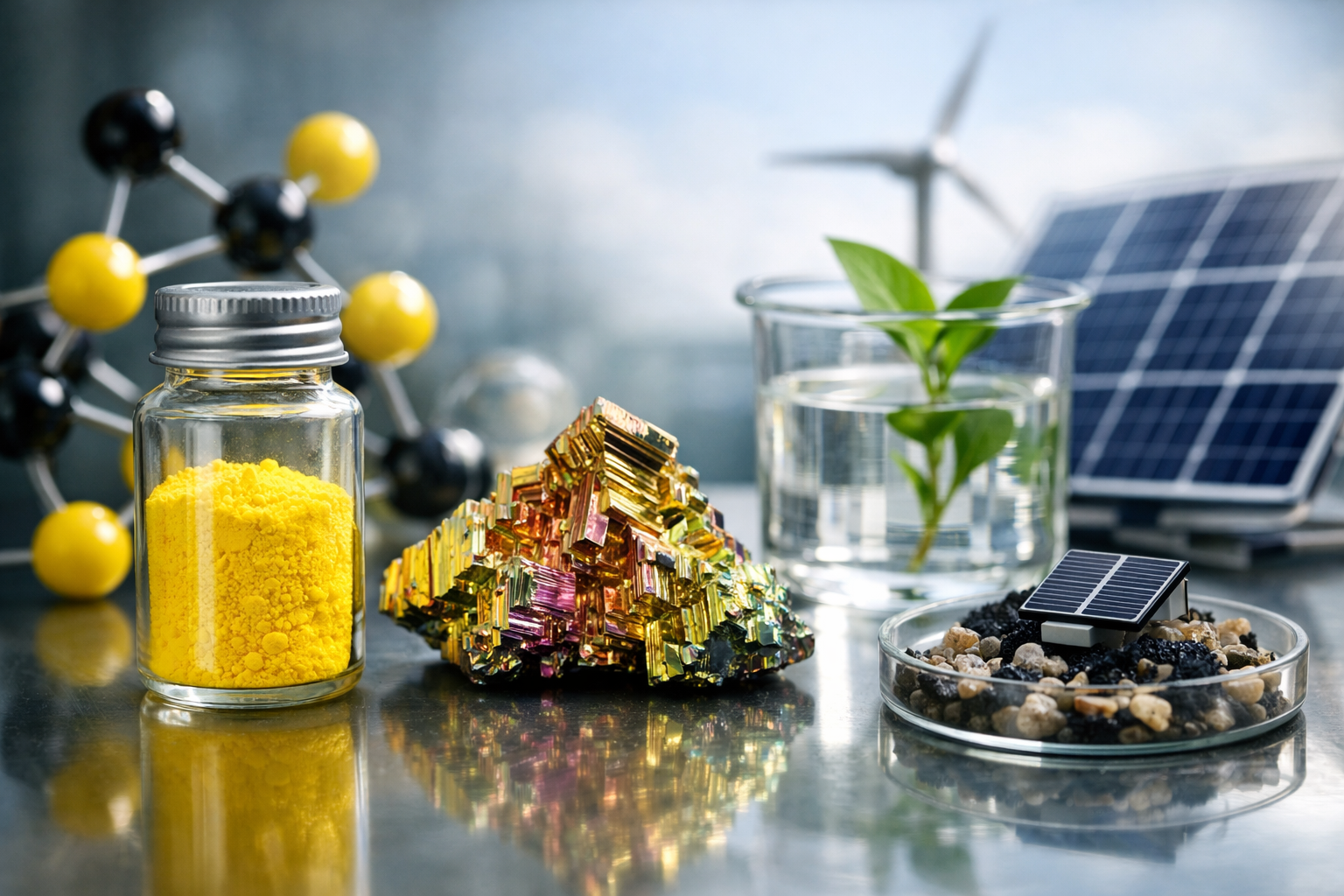
El bismuto es un semimetal (un material con propiedades a medio camino entre metal y no metal) de baja toxicidad que está ganando interés como alternativa más “verde” al plomo y otros metales pesados. En este artículo mostramos por qué México, como uno de los grandes productores mundiales de bismuto, tiene una oportunidad estratégica para impulsar materiales innovadores con impacto en la limpieza del agua, la energía limpia y la biomedicina. El foco está en el óxido de bismuto (Bi₂O₃), un material de color amarillo que puede activar reacciones químicas al recibir luz: es decir, funciona como fotocatalizador (aprovecha la luz para acelerar procesos que degradan contaminantes). Desde el Centro de Investigación en Química para la Economía Circular (CIQEC) se desarrollan dispositivos fotoactivos a base de bismuto para tratar agua contaminada con métodos sostenibles y de bajo costo. La invitación es clara: revalorar este recurso nacional como motor de innovación, el “oro amarillo mexicano de la ciencia”.
Citas
“Bismuth,” The Observatory of Economic Complexity (OEC), 2023. [Online]. Available: https://oec.world/es/profile/bilateral-product/bismuth/reporter/mex
R. Mohan, “Green bismuth,” Nature Chemistry, vol. 2, p. 336, 2010. doi: https://doi.org/10.1038/nchem.609
X. Liu and S. Handschuh-Wang, “Bismuth–Production, market and price development, and applications,” Canadian Metallurgical Quarterly, 2025. doi: https://doi.org/10.1080/00084433.2025.2465085
M. Esquivel-Gaona et al., “Bismuth-based nanoparticles as the environmentally friendly replacement for lead-based piezoelectrics,” RSC Advances, vol. 5, pp. 27295–27304, 2015. doi: https://doi.org/10.1039/C5RA02151K
S. L. Gorbach, “Bismuth therapy in gastrointestinal diseases,” Gastroenterology, vol. 99, no. 3, pp. 863–875, Sep. 1990. doi: https://doi.org/10.1016/0016-5085(90)90983-8
J. Amneklev, A. Augustsson, L. Sörme, and B. Bergbäck, “Bismuth and silver in cosmetic products: A source of environmental and resource concern?,” Journal of Industrial Ecology, vol. 20, no. 1, pp. 99–106, 2016.
S. Himeno, H. Fujishiro, and D. Sumi, “Bismuth,” in Handbook on the Toxicology of Metals, 5th ed., vol. 2. Elsevier, 2021, pp. 121–139. doi: https://doi.org/10.1016/B978-0-12-822946-0.00005-2
P. Chen et al., “Bi-based photocatalysts for light-driven environmental and energy applications: Structural tuning, reaction mechanisms, and challenges,” EcoMat, 2020. doi: https://doi.org/10.1002/eom2.12047
P. Gao et al., “A critical review on bismuth oxyhalide based photocatalysis for pharmaceutical active compounds degradation: Modifications, reactive sites, and challenges,” Journal of Hazardous Materials, 2021. doi: https://doi.org/10.1016/j.jhazmat.2021.125186
H. Li et al., “Recent advances in the application of bismuth-based catalysts for degrading environmental emerging organic contaminants through photocatalysis: A review,” Journal of Environmental Chemical Engineering, 2023. doi: https://doi.org/10.1016/j.jece.2023.110371
X. Meng and Z. Zhang, “Bismuth-based photocatalytic semiconductors: Introduction, challenges and possible approaches,” Journal of Molecular Catalysis A: Chemical, vol. 423, pp. 533–549, 2016. doi: https://doi.org/10.1016/j.molcata.2016.07.030
A. H. Zahid and Q. Han, “A review on the preparation, microstructure, and photocatalytic performance of Bi₂O₃ in polymorphs,” Nanoscale, vol. 13, no. 42, pp. 17687–17724, 2021.
M. T. Ayala-Ayala, M. Y. Ferrer-Pacheco, and J. Muñoz-Saldaña, “Manufacturing of photoactive β-bismuth oxide by flame spray oxidation,” Journal of Thermal Spray Technology, vol. 30, pp. 1107–1119, 2021. doi: https://doi.org/10.1007/s11666-021-01182-2
M. T. A. Ayala et al., “A Bi₂O₃/carbon composite as a short-circuited cell for water purification,” Journal of Water Process Engineering, vol. 79, p. 108857, 2025.
P. Babuji et al., “Human health risks due to exposure to water pollution: A review,” Water, vol. 15, no. 14, p. 2532, 2023.
M. T. Ayala-Ayala et al., “A short-circuited photo-assisted electrochemical cell for wastewater treatment,” Journal of Environmental Chemical Engineering, vol. 12, no. 4, 2024. doi: https://doi.org/10.1016/j.jece.2024.113269
M. L. Salazar-Lopez et al., “Surface oxidation pre-treatment on activated carbon: Effect on its cathode performance in electro-Fenton processes,” Materials Today Communications, vol. 34, p. 105290, 2023.
Publicado
Número
Sección
Licencia
Derechos de autor 2026 Dra. María Teresa Ayala Ayala, Dra. Brenda Alicia Rosales Pérez, Dr. Luis Arturo Godínez Mora-Tovar

Esta obra está bajo una licencia internacional Creative Commons Atribución-NoComercial-CompartirIgual 4.0.